
Exploring The Galapagos: Top Cruise Options for 2025
The Galápagos Islands sit 600 miles off Ecuador’s coast, a scatter of volcanic peaks where sea lions sprawl on white sand and blue‑footed boobies dance just feet from visitors. Because 70 percent of the archipelago’s visitor sites can be reached only by water, a small‑ship cruise remains the most comprehensive way to trace Darwin’s route and wake each morning off a different, otherwise inaccessible shore. Today a handful of lines operate purpose‑built expedition vessels—some intimate catamarans, others full‑suite yachts—while a few blue‑water cruise brands bolt Galápagos land programs onto longer South American sailings. Below are five distinct ways to see the islands.
Celebrity Cruises has spent 17 years refining its all‑inclusive, seven‑night program, now centered on the 100‑guest, all‑suite Celebrity Flora. Guests board in Baltra and circle a roster of wildlife hotspots twice daily with park‑certified naturalists, returning to a vessel that holds the region’s only Forbes Four‑Star rating, includes unlimited drinks and Wi‑Fi, and folds the park fee and snorkeling gear into the fare. Longer ten‑, eleven‑, and sixteen‑night packages stitch pre‑ and post‑cruise stays in Quito, Lima, or Machu Picchu onto the core week afloat, wrapping the trip in flights and five‑star hotels so travelers never touch a public terminal.
Lindblad Expeditions, which first anchored here in 1967, offers its ten‑day “Exploring Galápagos” journey aboard the 96‑passenger National Geographic Endeavour II or the new 48‑guest Gemini. Zodiac forays, glass‑bottom‑boat tours, and paddle‑boarding are guided by one naturalist for every ten travelers; certified divers can even arrange scuba on select departures. Fares include domestic flights to and from the islands, placing guests in Quito or Guayaquil on either end of a circuit that ranges from nesting frigatebirds on North Seymour to the giant tortoise highlands of Santa Cruz.
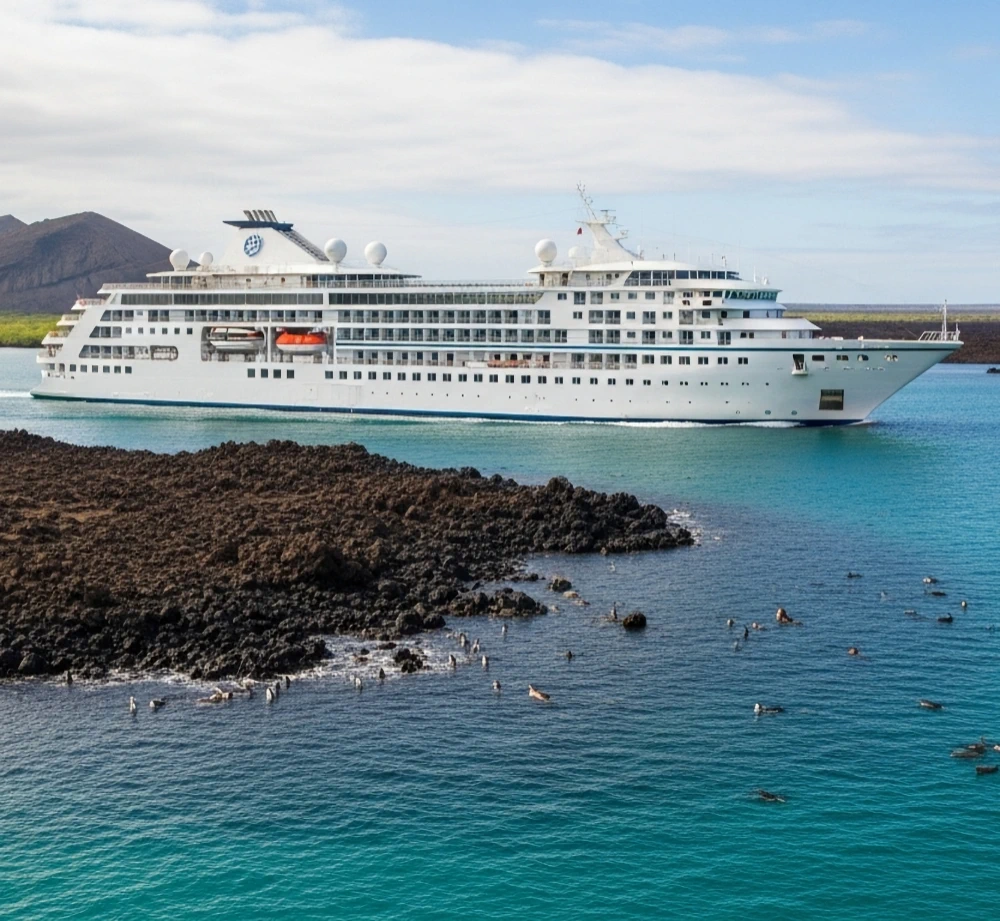
HX Hurtigruten Expeditions taps into the same expedition blueprint but on a slightly larger canvas: the 90‑guest MS Santa Cruz II. Seven‑, nine‑, eleven‑, and fourteen‑day sailings crisscross the western and northern islands, many departures pairing the cruise with guided time at Machu Picchu. HX touts a maximum of eleven guests per naturalist and an all‑inclusive fare that folds drinks, gratuities, and daily science‑center talks into the price. Savings offers and reduced deposits often headline its 2025–26 calendar, with the shortest, seven‑day “Iconic Wildlife & Sublime Scenery” route being the most affordable.
Travel designer Vaya Adventures curates space on more than thirty small yachts; a flagship example is the sixteen‑passenger Elite luxury catamaran. Regular four‑, five‑, and eight‑day loops are available, and emphasize a high guide‑to‑guest ratio, balcony suites, and open‑deck dining. Other vessels in its portfolio—including the first‑class Coral I & II twins or the new Galaxy Sirius—range from thirty‑six‑passenger yachts to sixteen‑guest catamarans, letting travelers match budget, cabin style, and departure date without sacrificing access to bilingual naturalists or core activities such as kayaking and snorkeling.
For mainstream cruisers already booked on a Panama Canal voyage, Holland America wraps the islands into a four‑night “Galápagos Overland Adventure.” Guests disembark in Manta, Ecuador, fly to Baltra, and board a chartered day‑yacht for outings to Bartolomé’s volcanic cone or North Seymour’s frigatebird rookeries. Evenings are spent in Santa Cruz hotels, and the package delivers tortoise encounters, guided snorkeling, most meals, and flights before returning guests to rejoin their ship in Lima. It is not a live‑aboard cruise, but it folds Galápagos highlights into a broader itinerary without a second ocean booking.
Whichever vessel—or hybrid land‑sea option—you choose, a Galápagos cruise trades the fixed lobby of a hotel for a moving balcony on evolution itself. The archipelago’s rules limit visitor numbers, so cabins sell out months ahead. Plan early, verify that the operator’s naturalists carry Galápagos National Park credentials, and be ready to swap dress shoes for wet‑suit booties. Once you have floated eye‑to‑eye with a sea turtle and hiked past a tortoise older than the Panama Canal, you will understand why travelers call the Galápagos less a destination than a once‑in‑a‑lifetime conversation with the planet itself.